
OpsClarity Blog
AI Readiness Assessment: What It Is and How to Score Your Business
By Abigale Haynes ·
An AI readiness assessment is a practical review of whether your business has the information, processes, people, and business case to use AI effectively, and what to fix first. It helps you decide where AI may help, where the groundwork is missing, and how to move forward without guessing.
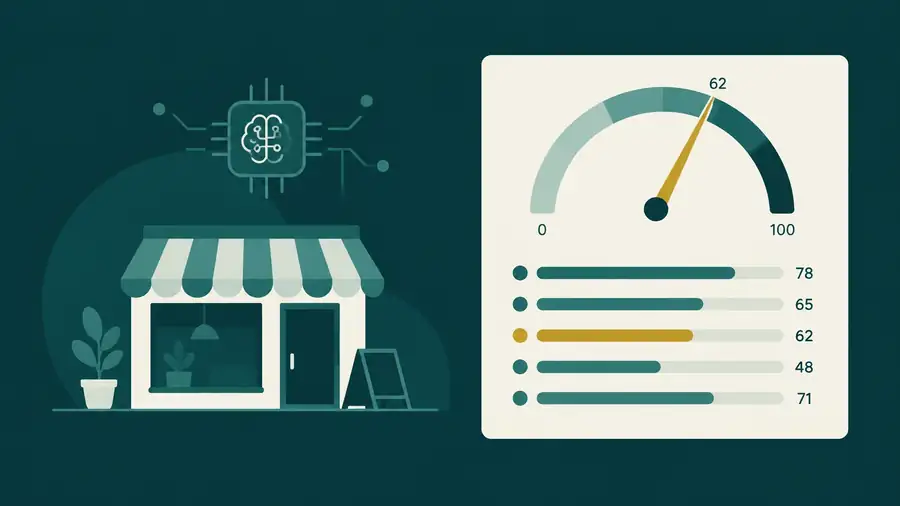
If you run a 20-person company, you do not need an enterprise AI readiness exercise built around a large data team, formal committees, and a complex technology estate. You need a clear view of the work your business actually does, the systems it uses, and whether a proposed change can pay off.
What does AI readiness mean for a small business?
AI readiness is not about having the newest software or being "good at technology." It is about being prepared to put AI into a specific business process and manage the results.
That means asking practical questions: Is the process clear enough to improve? Can the right information be found and used appropriately? Does someone have time to own the change? And can you measure whether it helped?
A useful AI readiness framework should give you more than a general verdict. It should show what is working, what is holding you back, and which next step makes sense. Here, that means looking at five dimensions.
The five dimensions in an AI readiness assessment
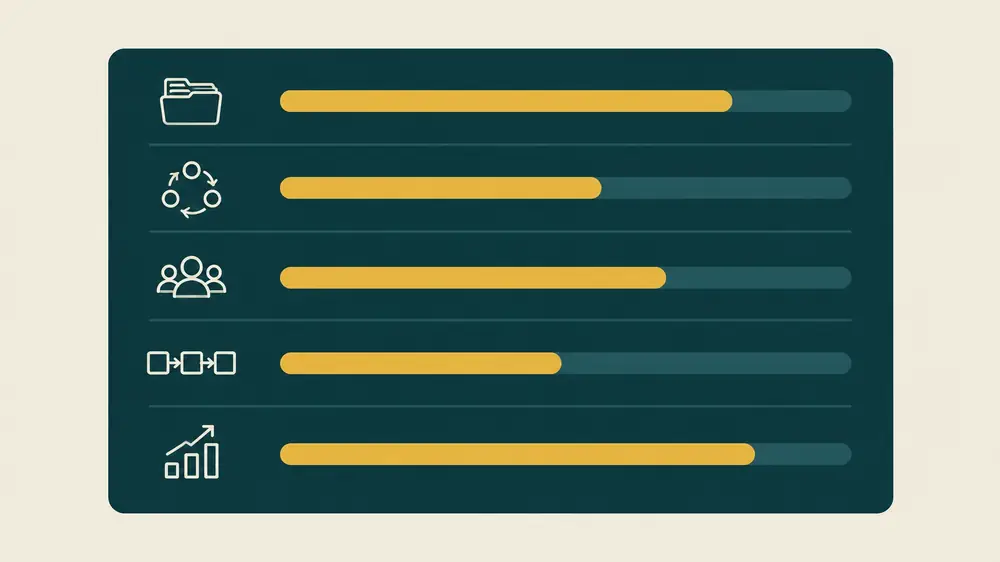
1. Data foundation
What it means: Can your team find the information a task depends on, and is it sufficiently accurate, current, and appropriate to use? This might mean customer records, job notes, pricing, contracts, or operating procedures, not necessarily a large database.
A low score often means: Important information is scattered across inboxes, spreadsheets, personal folders, or people's memories. It may be hard to confirm which copy is current or who is allowed to access it.
2. Process definition
What it means: Is the work understood from beginning to end? Can you describe the steps, decisions, handoffs, exceptions, and what a good result looks like?
A low score often means: Different employees do the same task in different ways, exceptions are handled by habit, or the process exists mainly in one experienced employee's head. AI is unlikely to fix a workflow nobody has clearly defined.
3. Team capacity
What it means: Is there someone who can make time for the work, help colleagues use a new process, check outputs, and deal with problems?
A low score often means: The team is already stretched, nobody is accountable for the change, or people have not agreed on how AI can and cannot be used. You do not necessarily need an AI specialist, but you do need an owner.
4. Pipeline hygiene
What it means: Are your day-to-day systems and handoffs orderly enough for a new tool or process to fit? Consider how leads, customer requests, work orders, invoices, and other records move through your business.
A low score often means: Records are incomplete or duplicated, follow-ups get missed, or staff repeatedly re-enter the same information. Those gaps can limit results even if an AI tool itself works as intended.
5. Commercial case
What it means: Is there a specific business problem worth solving, with a way to measure improvement? Think recovered hours, lower costs, faster response, fewer errors, or revenue influenced.
A low score often means: The idea is "we should use AI" rather than a defined task with a baseline, owner, expected outcome, and reasonable path to value.
How does a 0–100 AI readiness score work?
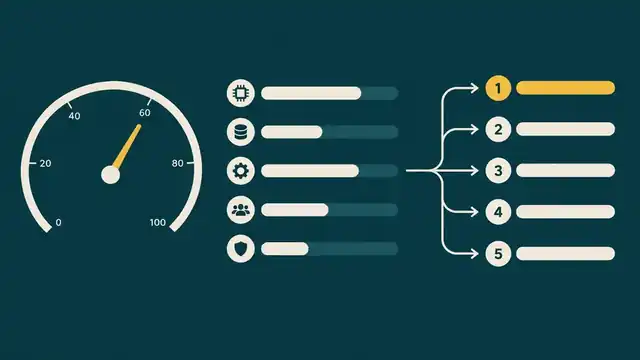
A score out of 100 combines results across the five dimensions. Each dimension contributes according to its weight in the assessment, so the final score reflects more than a simple yes-or-no checklist. The score is a starting position, not a verdict. A lower score can point to a fixable obstacle; a higher score does not mean every AI use case is suitable.
For a simple self-check, you might rate each dimension from 1 to 5: 1 means mostly absent or unknown; 3 means workable for a limited, controlled project; and 5 means consistent, owned, and measured. You can convert the ratings to a 0–100 scale, but record the evidence behind them. A score without reasons is just an opinion.
An assessment should also show the shape of the result. Two businesses could have similar totals but different next steps: one may need to clean up records, while the other needs a clearer workflow or a named owner.
How can a small business score itself?
Start with one process you might improve, not an abstract company-wide question like "Are we ready for AI?" Choose something recurring, such as preparing quotes, following up on enquiries, drafting routine updates, or handling job information.
Before scoring, gather a few useful examples:
- A sample of the records, documents, or messages used in the process.
- Any checklist, procedure, form, spreadsheet, or system record that describes the work.
- A rough view of volume, time spent, delays, errors, or missed handoffs.
- The person responsible for the process and the people who do it day to day.
- Any rules that affect access to customer or company information.
- A clear idea of what improvement would matter to the business.
Ask the owner or manager what outcome matters, but also ask the employees doing the work where information gets lost and where exceptions occur. If one person handles customer records or system administration, ask them how reliable those records and handoffs are. Comparing perspectives helps prevent a self-rating based only on how the process is supposed to work.
You do not need a technical background to do this. The point is to understand the operation before choosing a tool. For more on what comes after the diagnostic, see our guide to the AI adoption roadmap for small businesses. If your assessment raises data-use questions, our guide to ChatGPT safety for business is a helpful next read.
Common AI readiness scoring traps
Self-flattery. "We have all our data" may mean that files exist somewhere, not that the right employee can reliably find the current version. Ask for a real example instead of scoring from intention.
Scoring tools instead of operations. Owning a CRM or using an AI chatbot does not show that the tool is set up, adopted, or connected to a clear process. Score how the work happens, not the software list.
Treating a high commercial-case score as permission to buy. A worthwhile problem does not automatically mean a specific AI tool is the right answer. You still need to check data access, workflow fit, ownership, risk, and how you will test the result.
An illustrative AI readiness example
Illustrative example only: Imagine a small service firm assessing how it handles incoming enquiries. Its self-review gives these dimension scores: data foundation 55, process definition 40, team capacity 65, pipeline hygiene 45, and commercial case 80. Using illustrative weights of 25%, 20%, 20%, 15%, and 20%, respectively, the weighted total is 58 out of 100. These weights and scores are for explanation only; they are not presented as OpsClarity's actual scoring weights or as typical business results.
The strong commercial case says the enquiry process may be worth improving. But the low process and pipeline scores suggest that buying a new AI tool should not be the first move. A sensible roadmap might start by documenting how enquiries are handled, agreeing on required customer information, and fixing gaps in the follow-up process. Then the business could test a narrow, low-risk improvement and measure response time or completed follow-ups against its baseline.
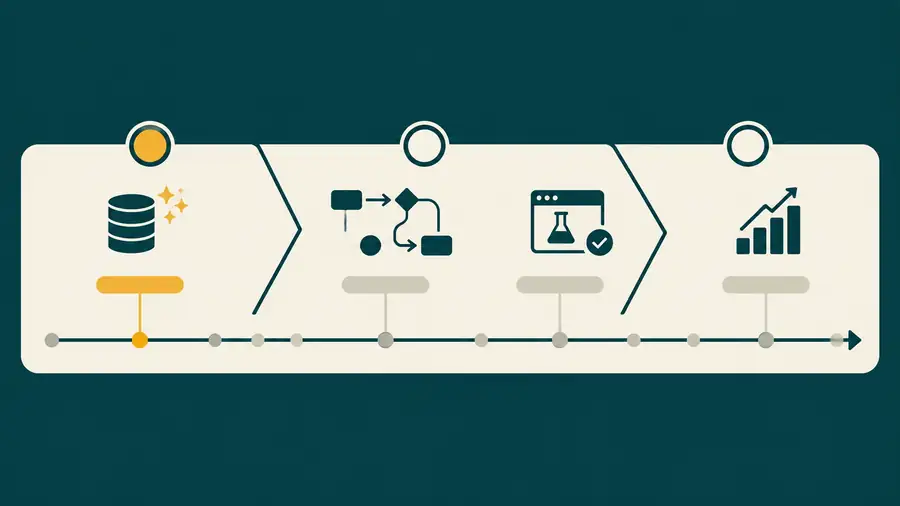
That sequence prioritizes practical groundwork and potential payback over novelty. A 90-day plan can make those steps clear: first prepare the process, then test a focused change, then review what the evidence shows.
What should a readiness assessment give you?
A useful assessment should leave you with a score you can understand, the reasoning behind it, and a prioritised roadmap. The roadmap should distinguish what is worth doing now from what should wait, and explain what not to do yet.
At OpsClarity, we assess five weighted dimensions: data foundation, process definition, team capacity, pipeline hygiene, and commercial case. The guided assessment takes one session; most owners complete it in about 45–70 minutes. It produces a score, a prioritised roadmap, and a baseline for measuring future results.
We do not sell AI tools, and the assessment does not require a retainer. It is a standalone starting point for deciding what makes sense for your business. You can read more about how our approach differs from traditional AI consulting firms.
Get your AI Readiness Assessment
Get a scored view of your operations and a roadmap ranked by what pays for itself first. The OpsClarity AI Readiness Assessment takes one session, starts at $497, and includes 90 days of support as you act on the roadmap.
Prefer to talk first? Book a call.
Frequently asked questions
What is an AI readiness assessment?
It is a review of whether your business has the information, processes, people, and business case needed to use AI effectively. It should help identify practical gaps and prioritize next steps.
Is an AI readiness assessment useful for a small business?
Yes. A small business can use one to evaluate a specific workflow, identify what needs attention, and avoid buying tools before it understands the problem. It should be scaled to the business, not built around enterprise staffing and systems.
How long does an AI readiness assessment take?
OpsClarity's guided assessment is completed in one session. Most owners complete it in about 45–70 minutes.
Does a high AI readiness score mean we should buy an AI tool?
No. A score is a starting point, not a purchase recommendation. A sensible decision also considers the specific workflow, information access, team ownership, risks, and how results will be measured.